
Search results: 86
SCGR2025EN
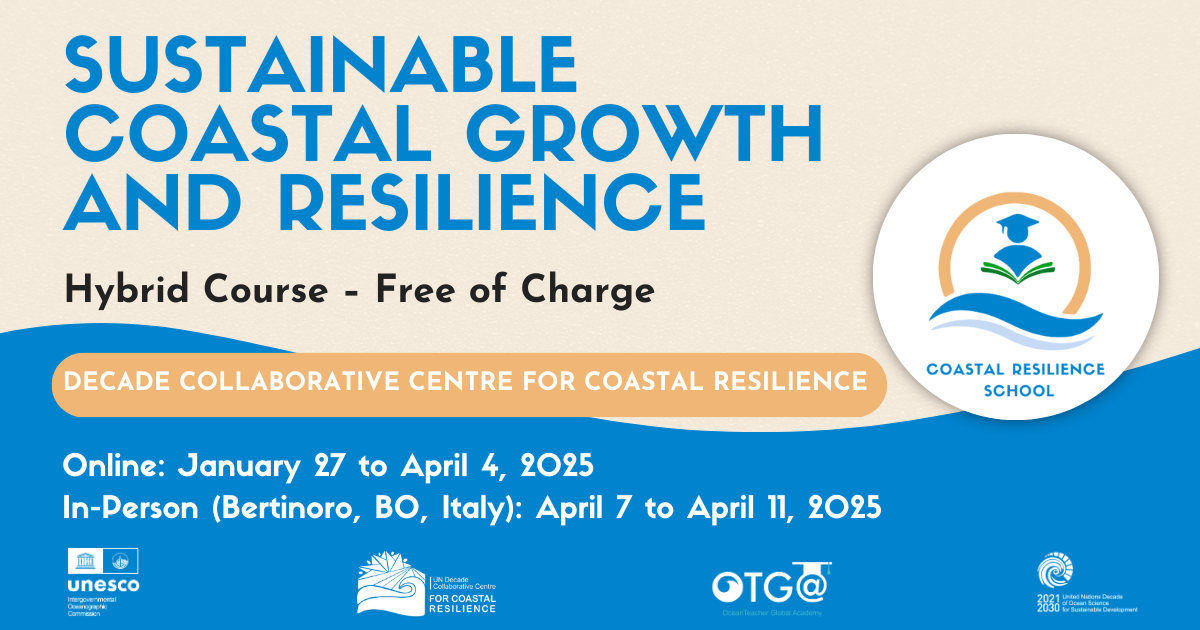
Sustainable Coastal Growth and Resilience
Summary
This hybrid course, organized by the Decade Collaborative Centre for Coastal Resilience, provides an in-depth exploration of coastal resilience and its vital role in supporting sustainable business practices and protecting communities against climate change-related impacts. Through five interconnected modules and an in-presence hands-on week, participants will learn and implement the principles, technologies, and strategies needed to understand, assess, and bolster resilience within coastal regions, while emphasizing business responsibility and proactive risk management.
Venue
The course will be subdivided into two phases:
An online phase will take place through OTGA e-learning platform.
An in-person phase which will be held in Bertinoro, Italy, at the University Residential Center of Bertinoro (CE.U.B.).
Learning outcomes
By the end of the course the participants should be able to:
- Understand Coastal Resilience and its Business Implications
- Utilize Operational Oceanography Products for Hazard Analysis
- Assess Environmental Impact and Manage Coastal Risks
- Apply Enabling Technologies to Coastal Resilience Challenges
- Develop Practical Resilience Solutions for Critical Coastal Infrastructure
- Showcase innovative solutions executing a Real-World Coastal Resilience Project
Target audience
The course is a post-graduate and early-career course for professional development and continuing education. The course is particularly aimed at early-career scientists, young professionals from coastal consulting firms, coastal managers and operators, as well as members of environmental protection agencies and civil protection organizations.
Pre-requisites
Course content
- Overview of Coastal Resilience and its Business Implications
- Understanding Coastal Hazards Using Operational Oceanography
- Environmental Impact Assessment and Risk Management
- Enabling Technologies for Coastal Resilience
- Innovative Solutions for Coastal Resilience
Language of instruction: English
Course Duration
The course will span a total of ten weeks (~90 hours in total) from 27 January to 11 April 2025 in hybrid format, with the structure includes the following:
- Five week-modules of online asynchronous learning (10 hours per week - 50 hours total)
- Five weeks of Webinars (1-2 hours per week - 10 hours total) and tutoring sessions (20 hours)
- One-week in-person workshop, 7-11 April 2025 (30 hours)
Certificate
OTGA - ISO Certificate will be awarded to the participants upon completion of assignments, assessment tests, and delivery of a project according to the course planning.
Notes
Application process
**(APPLICATIONS FOR THIS COURSE ARE NOW CLOSED)**
A limited number of seats (25) are available. Please fill out the online application form available at this LINK:https://otga.wufoo.com/forms/z3uoa8z1fqqqpu/
The applications start on 15 November 2024. The deadline to submit the application is 15 December 2024 (23:59 CET: Central European Time).
- CV containing (upload)
- Description of Education and information on Masterʼs degree in relevant fields.
- Description of Professional Experience
- Current position
- English Proficiency Certificates
- Motivation Letter - 1000 words- explaining alignment with course goals
- Reference Letters (optional but encouraged) (upload)
Selection criteria
UNESCO is committed to promoting equal access principles. Applications from minority or underrepresented groups are strongly encouraged.
Selection will be based on:
- Pertinence of Master's degree
- Relevant work experience in coastal management, environmental consulting, urban planning, marine conservation, or related fields
- Proficiency in written and spoken English
- Submission of a complete application
Priority consideration will be given to applicants from underrepresented countries, particularly in the Global South.
Costs
Free of charge. There are no tuition fees.
This course is offered with no tuition fees, and all participation costs will be fully covered by the organizers. Full financial coverage for in-person week will be provided by the Decade Collaborative Center for Coastal Resilience (DCC-CR).
Contacts
For any questions, please contact OTGA Secretariat (ioc.training@unesco.org) or DCC-CR secretariat (difa.dcc-cr@unibo.it) always using the name of the course as e-mail subject.
Cancellation policy
In the event of cancellation of the course by the OTGA or its affiliates, we will provide notification of cancellation at least 7 days prior to the course date. In the event of cancellation by the attendee, we should receive notification of cancellation at least 7 days prior to the course date.
SCGR2026online Asia-Pacific
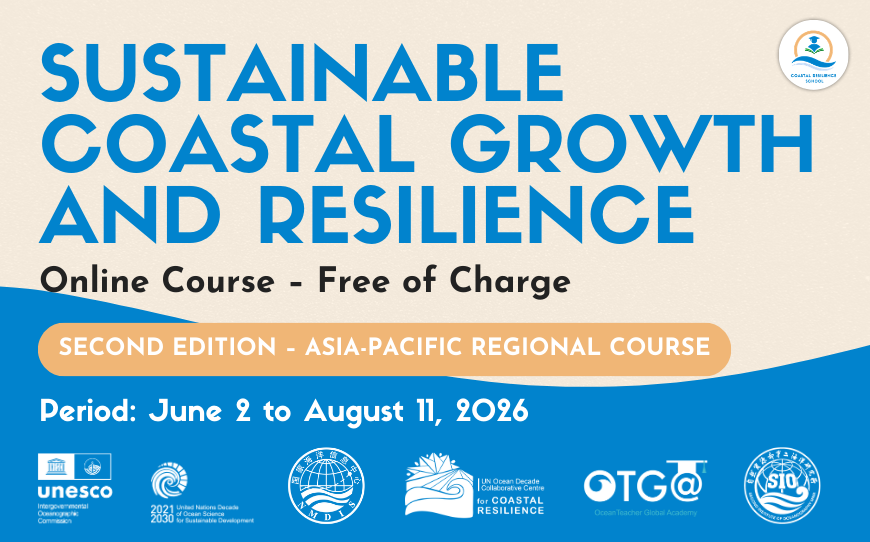
Sustainable Coastal Growth and Resilience_2026
This comprehensive course provides an in-depth exploration of Coastal Resilience concepts that are key in supporting sustainable business practices and protecting communities against natural hazards and climate change-related impacts. Through five interconnected online modules and a range of interactive learning activities, participants will learn and implement the principles, technologies, and strategies needed to understand, assess, and bolster resilience within coastal regions, while emphasizing business responsibility and proactive risk management tailored to Asia-Pacific context.
Building on the success of its first edition, this course is a fully online training focused on the Asia-Pacific regional needs and priorities, jointly coordinated by the Second Institute of Oceanography of China, Ministry of Natural Resources (SIOMNR), the IOC OceanTeacher Global Academy Regional Training Centre China (National Marine Data and Information Service-China, NMDIS), the Decade Collaborative Centre for Coastal Resilience (DCC-CR), the Western Pacific Subcommission of the Intergovernmental Oceanographic Commission of UNESCO (IOC WESTPAC), Decade Capacity Development Facility (CDF), the Euro-Mediterranean Center on Climate Change (CMCC) of Italy and the CINECA Interactive Computing Services in Bologna, Italy.
Needs and priority
This training contributes to Intergovernmental Oceanographic Commission of UNESCO (IOC)'s action on enhancing the capacity of its Member States to access technology, physical infrastructure, data and information through promoting human resources development at individual and institutional levels (output 1 and 2 of IOC Capacity Development Strategy, 2023-2030); and to the UN Ocean Decade by addressing capacity development needs of partners involved in current and future actions.
This activity also contributes to the implementation of IOC Medium-term Strategy (2022-2029) and IOC WESTPAC Call to action SGOs Tokyo Statement, by facilitating initiatives to improve resilience to climate change and contribute to its mitigation.
Learning outcomes
After completing this course, participants will be able to:
- Understand the fundamentals of coastal resilience and its implications for science-based services and operations.
- Utilize operational oceanography products for hazard assessment.
- Apply enabling technologies to coastal resilience challenges.
- Develop practical resilience solutions for critical coastal infrastructure.
- Showcase innovative applied solutions through Real-World coastal resilience projects
Course content
The course is composed of five online modules:
- Overview of Coastal Resilience and its importance for Business
- Understanding coastal hazards from operational oceanography products
- Impact Assessment and risk management
- Enabling technologies for Coastal Resilience
- Solutions for Coastal Resilience
The content will be further complemented by interactive discussions, case studies, and collaborative learning activities to support knowledge exchange and practical application.
Target audience
This course is designed for early-career ocean scientists and professionals as part of their professional development and continuing education. It is especially intended for early-career ocean scientists and professionals working in coastal consulting firms, coastal managers and operators, and staff from environmental protection and civil protection agencies. Priority will be given to researchers and technical staff (such as managers and operators) from national and international institutions involved in ocean science, marine services, and ocean management in the Asia-Pacific region.
The eligible list of countries includes: Bangladesh*, Brunei Darussalam, Cambodia, China*, Cook Islands*, Democratic People's Republic of Korea*, Federated States of Micronesia, Fiji*, French Polynesia, Indonesia*, Kiribati*, Lao PDR, Malaysia*, Maldives*, Myanmar*, Nauru*, New Caledonia, Niue*, Palau*, Papua New Guinea*, Philippines*, Republic of the Marshall Islands, Samoa*, Solomon Islands*, Sri Lanka*, Thailand*, Timor-Leste*, Tonga*, Tuvalu*, Vanuatu*, Viet Nam*. (* are IOC Member States).
Pre-requisites
Educational and Professional Qualification:
-
A minimum of a Masters degree in one of the following fields: Environmental Sciences, Marine Biology, Coastal Engineering, Urban Planning, Political Science, International Affairs, Economics, Business, or a related discipline; OR a minimum of 5 years of relevant work experience in areas such as coastal management, environmental consulting, urban planning, marine conservation, or other related fields.
-
Professional affiliation with national or international infrastructure (within ocean/marine or related entities and agencies) and/or 1-5 years of relevant work experience in coastal management, environmental consulting, urban planning, marine conservation, or related fields.
Language Proficiency:
-
Demonstrated proficiency in written and spoken English.
Additional Requirements:
-
Submission of a complete application, including a Statement of Purpose.
-
Priority consideration will be given to international applicants from Least Developed Countries or Small Island Developing States in the Asia-Pacific Region. See the list of eligible countries above.
Technology requirements/computer skills:
- Basic computer skills and experience in working in a digital learning environment.
- Experience with QGIS and Python programming (Jupyter notebooks environment).
Language of instruction: English
Course Coordinators
Contributing subject experts will be available later on.
Course Format & Duration
The online modules include both self-paced activities and weekly synchronous sessions (attendance is strongly recommended and tracked, but not mandatory). The online modules comprise an estimated 70 hours of training and will be available from 2 June until 11 August, 2026.
Assessment & Certificate
This course contains self-paced automated assessments as well as written and oral assignments. A certificate will be awarded to the participants upon successful completion of:
- All modules and lessons;
- Assessments and assignments (passmark: 70%);
- Completion of a pre and post-test; and
- Completion of a feedback survey.
Application
A limited number of seats are available, to be confirmed by the organizers at a later stage, depending on the support and accessibility required to the training activities.
Applications process will run through OTGA online form. Please fill out the online application form available at this LINK. Applications open on 11 March 2026. The deadline to submit the application is 26 March 2026 (23:59 CET: Central European Time). Extended deadline: 02 April 2026 (23:59 CEST). NEW and LAST Extended deadline: 8 April 2026 (23:59 CEST).
Documents requested
Applicants will be requested to describe and/or upload the following documents and information:
- CV containing a description of education and technical background, a description of professional experience, details on the current affiliation;
- Proof of English Proficiency (Fluency); and
- A Statement of Purpose of 1000 words explaining motivation and alignment with course goals, and requirements.
Additional documentation, such as a letter of endorsement of affiliated institution and personal documents, may be requested by OTGA during the selection process.
Selection criteria
UNESCO is committed to promoting equal access principles. Applications from minority or underrepresented groups are strongly encouraged.
Selection will be based on fit to the best fit to the pre-requisites mentioned above.
Costs
Free of charge. There are no tuition fees.
Contacts
For any questions, please contact OTGA Secretariat (ioc.training@unesco.org) always using the name of the course as e-mail subject.
Cancellation policy
In the event of cancellation of the course by the OTGA or its affiliates, we will provide notification of cancellation at least 7 days prior to the course date. In the event of cancellation by the attendee, we should receive notification of cancellation at least 7 days prior to the course date.

Training course and Identification Qualification in Harmful Marine Microalgae 2026(1)
Since 1993 the IOC has conducted training courses on harmful microalgae. The purpose has been to improve the taxonomic and identification skills of the participants for research purposes and for practical monitoring of harmful algal blooms.
From 2006 the IOC training in HAB identification has been offered within a new framework which gives accreditation. The present course includes now a practical exam at the end of the course with an IOC Certificate of Proficiency in Identification of Harmful Algae issued to participants who pass the exam. We know by experience that many of the more than 500 trainees we have had over the years have wished the courses to give accreditation, and in some countries, the IOC courses have become a reference for laboratories to be approved for carrying out regulatory monitoring for harmful microalgae.
The IOC Science and Communication Centre on Harmful Algae, University of Copenhagen, Denmark is organizing the course.
IOC Training Course and Identification Qualification in Harmful Marine Microalgae 2026
Course description: The course includes 100 hours of teaching and is divided into two parts. 1) The first part of the course is organised online using the elearning platform of IOC/IODE/OceanTeacher Global Academy, giving general introductions to the various groups of harmful algae; this part is mainly for self-study and estimated to 40 hours of reading. 2) The second part is a practical course in species identification (see tentative programme below). Part 2 includes 60 hours of teaching and a microscope will be available to each participant during the entire period, see also link below.
Participants: The course is aimed at participants who have some years of practical experience in identification of microalgae. The number of participants is limited to 16. If there are more applicants than available seats, priority will be given to applicants who have direct research or management responsibilities with regard to the occurrence of harmful algae.
Dates: Part 1 will be offred through the eLearning platform of OTGA’ from October onwards; part 2 takes place from 28 February 2026
Venue on site: IOC Science and Communication Centre on Harmful Algae, Department of Biology, University of Copenhagen, Denmark.
Language: English.
Course lecturers: Dr. Santiago Fraga, Dr. Jacob Larsen, Dr. Nina Lundholm, Professor Øjvind Moestrup.
Enquiries may be sent to Jacob Larsen, jacobl@bio.ku.dk
Price: The course is organized on a cost-recovery basis. The price of the course is 4200 EUR and it is a package deal, which covers all expenses during the course period, see also link below; thus
- Accommodation, - c/o Danhostel, Lejrskolevej 4, 3400 Hillerød.
- All meals during the course, starting with an evening meal upon arrival
- Access to the distant learning programme on the OceanTeacher Global Academy eLearning platform
- Teaching material including hard copies or pdf-versions of the following books which will be distributed during the practical part of the course:
- Lassus, P., Chomérat, N., Hess, P. & Nézan, E. 2016. Toxic and Harmful Microalgae of the World Ocean. – Denmark. International Society for the Study of Harmful Algae / Intergovernmental Oceanographic Commission of Unesco. IOC Manuals and Guides 68, 523 pp. (hard copy)
- Hoppenrath, M., Chomérat, N., Horiguchi, T., Murray, S.A. & Rhodes, L. 2023. Marine benthic dinoflagellates – their relevance for science and society (2nd, revised edition). - Senckenberg Gesellschaft für Naturforschung, Frankfurt am Main, Germany. Senckenberg Buch vol. 88, 376 pp.
- Karlson, B., Cusack, C. & Bresnan, E. (eds). 2010. Microscopic and molecular methods fro quantitative phytoplankton analysis. – IOC Manuals and Guides 55, Paris, Unesco, 110 pp. (pdf-version)
- Larsen, J. & Nguyen, N.L. (eds). 2004. Potentially toxic microalgae of Vietnamese waters. – Opera Bot. 140: 5-216 (pdf-version)
- Reguera, B., Alonso, R., Moreira, A., Méndez, S., Dechraoui-Bottein, M.-Y. (eds). 2016. Guide for designing and implementing a plan to monotor toxin-producing microalge. 2nd ed. – IOC Gudies and Manuals 59, Intergovernmental Oceanographic Commission (IOC) of Unesco and International Atomic Energy Agency (IAEA), Paris and Vienna, 66 pp. (pdf-version)
- Proceedings from various HAB conferences (pdf-versions)
- Copies of all lectures given during the course
- Use of facilities, microscopes, samples, and cultures
- Tuition during the practical part of the course
Species identification
This part of the course will focus on identification of harmful algal species by light microscopy, with particular reference to the ‘IOC Taxonomic Reference List on Toxic Plankton Algae’. The use of electron microscopy will be introduced, but practical exercises are not included. During the course, the following species will be demonstrated either as cultures (*subject to the availability of cultures) or as preserved material.
Haptophyceae*: Chrysochromulina spp. Prymnesium spp.
Raphidophyceae*: Chattonella antiqua, C. ovata, C. subsalsa, Fibrocapsa japonica, Heterosigma akashiwo, Olisthodiscus luteus (Olisthodiscophyceae).
Dictyochophyceae*: Pseudo-chattonella verruculosa
Dinophyceae: Prorocentrum concavum, P. cordatum, P. emarginatum, P. gracile, P. obtusidens, P. hoffmannianum, P. lima, P. micans, P. rhathymum, P. rostratum, P. scutellum, P. triestenum
Dinophysis acuta, D. acuminata, D. caudata, D. fortii, D. miles, Phalacroma mitra, D. norvegica, P. rotundatum, D. tripos
Alexandrium affine, A. minutum*, A. catenella, A. ostenfeldii, A. pacificum*, A. pseudogonyaulax, A. tamarense, A. taylorii
Pyrodinium bahamense, Lingulodinium polyedrum, Protoceratium reticulatum, Gonyaulax polygramma, G. spinifera, Vulcanodinium rugosum, Gambierdiscus spp, Coolia spp., Ostreopsis spp.
Akashiwo sanguinea*, Amphidinium carterae*, Margalefidinium polykrikoides*, Gymnodinium catenatum*, G. impudicum*, Karenia mikimotoi*, K. papilionaceae*, K. selliformis*, Karlodinium armiger*, K. micrum*, Noctiluca scintillans.
Bacillariophyceae: Pseudo-nitzschia australis, P. calliantha*, P. delicatissima, P. fraudulenta, P. multiseries, P. pungens*, P. seriata, Nitzschia navis-varingica.
Cyanobacteria: Anabaena spp, Anabaenopsis spp, Aphanizomenon spp., Cylindro-spermopsis spp., Microcystis spp, Nodularia spumigena, Trichodesmium sp.
Feedback survey
At the end of the course, you will be asked to fill out a feedback survey. This information will be used to improve future courses. Note: submitting the course feedback survey is mandatory to obtain the course certificate
Certificate: A certificate of completion will be awarded to all participants who attended all classes and activities and completed the final test onsite.
Cancellation policy:
In the event of cancellation of the course by the OTGA or its affiliates, we will provide notification of cancellation at least 7 days prior to the course date. In the event of cancellation by the attendee, we should receive notification of cancellation at least 7 days prior to the course date.
Tsunami
Tsunami Mitigation
Course description
This training provides an in-depth understanding of tsunami mitigation strategies, emphasizing early warning systems and effective risk communication. Participants will explore the principles and mechanisms behind tectonic and non-tectonic tsunami early warning systems, focusing on their implementation in Indonesia. The course will also cover real-world case studies from Indonesia and Japan, providing hands-on learning experiences to enhance practical skills.
Learning outcomes
- understand the principles and best practices of tsunami mitigation
- Understand the basic knowledge of tectonic-tsunami early warning system
- Understand the basic knowledge of non-tectonic tsunami early warning system
- Able to communicate the risk of tsunami
- Able to demonstrate the case study of tsunami mitigation presented during the hands-on
The course content is listed as follows
- Overview of Global Tsunami Mitigation
- Tsunami Literation and Mitigation, Case study in Japan
- Tsunami Mitigation, Case study in Indonesia
- Introduction to Tectonic-Tsunami Early Warning System in Indonesia
- Introduction to Non Tectonic-Tsunami Early Warning System in Indonesia
- Risk Communication
By the end of this training, participants will be equipped with the knowledge to assess tsunami risks, communicate effectively in crisis situations, and apply mitigation measures in their respective fields. Through hands-on training in cutting-edge data processing techniques, participants will gain the scientific expertise needed to derive accurate insights, enhancing their capabilities to contribute effectively to mitigate tsunami.
The major learning activities of the training will be included
- Lectures
- Discussions
- Case studies
- Coaching
- Hands-on
- Exercise
- Action Plan
synchronous sessions
There will be synchronous sessions every day (see agenda)
Target audience and prerequisites
The primary targeted audience will be disaster management professionals, researchers, policymakers, and anyone who is involved in tsunami mitigation and risk reduction strategies activities. Participants have at least a bachelor's degree or have an equivalent level of academic background geophysics, seismology, or any subject relevant to disaster management, preferably under the age of 45 years old, and have sufficient command of spoken and written English.
Language of instruction
English
Instructors
- Overview of Global Tsunami Mitigation: Dr. Nelly Florida Riama (14 July 2025)
- Tsunami Literation and Mitigation, case study tsunami Japan of 1 January 2024: Professor Megumi Sugimoto (14 July 2025)
- Tsunami Mitigation, case study tsunami Indonesia: Dr Weniza (15 July 2025)
- Introduction to Tsunami Ready Recognition Program: Ms Suci Dewi Anugerah (15 July 2025)
- Lesson learnt on Tsunami Ready Implementation in Indonesia: Mr. Admiral Musa (15 July 2025)
- Introduction to Tectonic-Tsunami Early Warning System in Indonesia: Dr Wijayanto (16 July 2025)
- Introduction to Non-Tectonic-Tsunami Early Warning System in Indonesia: Mr Januar Arifin (17 July 2025)
- Risk Communication: Professor Ota Yoko (18 July 2025)
course duration (1 learning hours = 45 minutes):
- Synchronous: 24 learning hours
- Asynchronous: 18 learning hours
- Total: 42 learning hours
Learner assessment
Initial assessment will be done through the pre-test before the class starts.
For formative evaluation, assignments and discussions the OTGA/BMKG Learning Management System will be used .
For the summative assessment, at the end of the course, participants will have a post-test and have to write an action plan on how they will implement the knowledge they gained during the training and a report following a timeline of the proposed action plan.
Certificate
a certificate will be issued if the participant meets the criteria
- present in all sessions/class (100% attendance)
- completed a minimum of 90% of all the assignments
- receive a score of 60 out of 100 on the post-test
Technology requirements
Participants are required to have access to a computer (laptop or PC) with a stable internet connection. Basic proficiency in Microsoft Office (Word, Excel, and PowerPoint) is necessary for completing assignments and engaging with course materials. No advanced IT skills are required.
Pre-requisites no
Application process
A limited number of seats (30) are available. Please fill out the online application form available at this LINK
The deadline to submit the application is 25 June 2025 (23:59 CET: Central European Time).
Selection criteria
- Relevance to the Field – Applicants must have relevancy in tsunami mitigation, disaster management, or other related fields in their work/ studies.
- Completion of Registration Documents – Applicants must submit all required registration documents within the specified deadline to be considered for selection.
Costs
Free of charge. There are no tuition fees.
Contacts
For any questions, please contact OTGA Secretariat (ioc.training@unesco.org) or Anni Arumsari Fitriany (anni.arumsari@bmkg.go.id) always using the name of the course as e-mail subject.
Cancellation policy
In the event of cancellation of the course by the OTGA or its affiliates, we will provide notification of cancellation at least 7 days prior to the course date. In the event of cancellation by the attendee, we should receive notification of cancellation at least 7 days prior to the course date.
https://oceanexpert.org/event/4793
IOOSOBIS2018
U.S. Integrated Ocean Observing System (IOOS) Biological Data Training Workshop
This workshop builds on the successful partnership between the U.S. Integrated Ocean Observing System (IOOS) and the Ocean Biogeographic Information System (OBIS-USA) in coordination with IOC’s OceanTeacher Global Academy, and OBIS international to develop a community of practice around the management and analysis of marine biological data. It will provide hands-on training in a computer lab setting and is intended to educate participants on the benefits, goals, technology and process to standardize biological data (and associated physical or chemical data) and make it accessible via OBIS and IOOS, including the MBON Portal. The workshop will also expose participants to OBIS, IOOS and MBON applications for using those data.
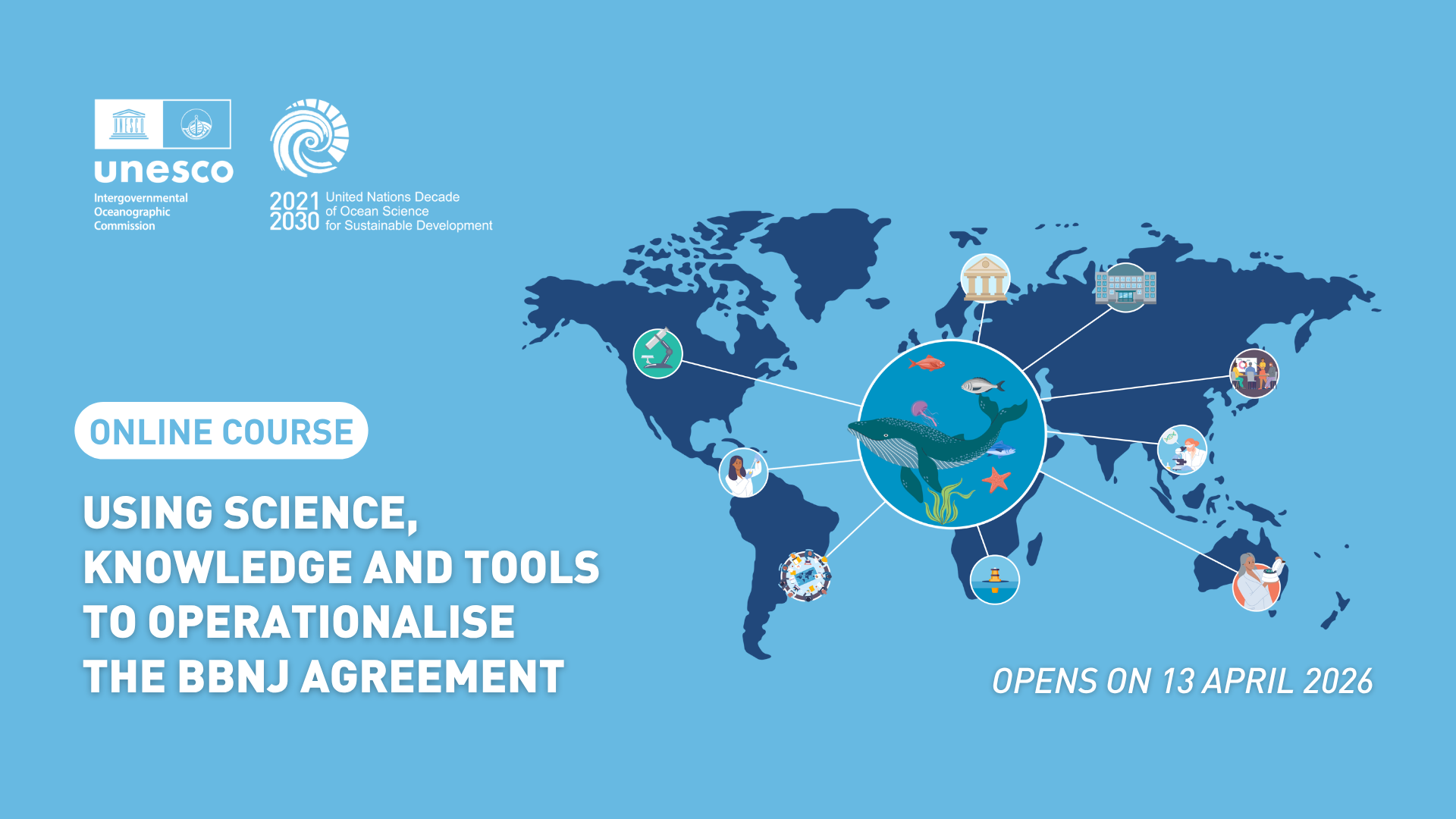
IOC BBNJ 2026
Using Science, Knowledge & Tools to operationalise the BBNJ Agreement
Background
A legally binding agreement for the conservation and sustainable use of marine biological diversity of areas beyond national jurisdiction (BBNJ Agreement) is the third implementing agreement under the United Nations Convention on the Law of the Sea. Entry into force in January 2026 marks 20 years since discussions at UN level had begun. The BBNJ Agreement combines the conservation of marine species and their sustainable use and includes diverse stakeholders in the future design of ocean governance, including Indigenous Peoples and local communities, scientists, industry, and decision-makers. It is a significant step towards comprehensive protection and use of marine biodiversity in areas beyond national jurisdiction.
The Agreement establishes a number of subsidiary bodies and mechanisms for its implementation: a scientific and technical body, providing science and knowledge advice in the process; a clearing house mechanism as a centralized data sharing platform, a financial mechanism, and various committees on benefit-sharing, capacity building and technology transfer, and implementation and compliance. Science and knowledge play a crucial role in the implementation of the agreement and are the focus of this course.
Course overview and objectives
This online training introduces the BBNJ Agreement and focuses on the role that ocean science and knowledge play for its implementation, including implications for the global community and opportunities for science, services and management in and about ABNJ.
The course aims to support individuals and institutions of diverse groups in understanding the scientific realities of the ocean and data sharing opportunities (i.e. across maritime zones between countries and different ocean depths; between the Exclusive Economic Zones and High Seas; and across sectors and geographical regions for enhanced cooperation and coordination with and among other instruments, frameworks and bodies).
The use of science and knowledge on the ocean and its marine ecosystems are particularly evident in operationalization of the Agreement’s processes to assess potential impacts on the marine environment of planned activities, including in considerations for strategic environmental assessments and when assessing cumulative impacts, as well as in the establishment of area-based management tools, including marine protected areas, in the efforts to conserve and sustainably use marine biodiversity through geographical tools in a dynamic, connected and changing ocean. Additionally, understanding capacity needs, accessing existing capacity building and technology transfer initiatives, provided by different institutions and linking different types of ocean data and information can strengthen our knowledge on marine biodiversity in an interconnected ocean.
Format and Duration
This is a self-paced online course, comprising various learning resources, activities and assessments, with a total of 20 hours estimated for completion.
Language of instruction: English
Learning outcomes
After successfully completing this course, learners will:
- Have an improved understanding about the context out of which the BBNJ Agreement emerged
- Be able to detail its objectives and four pillars
- Recognize the potential implications of the BBNJ Agreement for national, regional and global contexts—particularly in terms of ocean science, area-based management, activities in ABNJ, environmental impact assessment, and capacity building and the transfer of marine technology
- Be able to name databases and services useful for the operationalization of the BBNJ Agreement
- Know how to consider the scientific realities of a connected and changing ocean in policy measures and management
- Be sensitive to a variety of actors active in exploring, protecting, using and valuing the ocean.
- Recognize factors for successful operationalization of the agreement.
Course content
The course is composed of three online modules:
Module 1. Introduction to marine biodiversity of areas beyond national jurisdiction, which provides an overview of natural environment of the open ocean, existing ocean governance framework, and the related ocean science and knowledge.
M1-Lesson 1. Life in the Sea: A connected and changing ocean
M1-Lesson 2. Ocean Biodiversity Governance
M1-Lesson 3. Global Ocean Science & Knowledge
Module 2. BBNJ Agreement in Practice, which covers elements & aims of the Agreement, technical competencies needed for its operationalization across all pillars, and needs and priorities for ocean science.
M2-Lesson 1. Marine Genetic Resources
M2-Lesson 2. Area-Based Management Tools, including Marine Protected Areas
M2-Lesson 3. Environmental Impact Assessment
M2-Lesson 4. Capacity Building and Transfer of Marine Technology
M2-Lesson 5. Cross-cutting topics
Module 3. Actors, Mechanisms, Data Sharing and Tools under the BBNJ Agreement, which covers opportunities for individuals and nations, pathways for strengthening cooperation and coordination in the implementation of the Agreement, reflections on emerging technologies, and the intrinsic value of marine biodiversity.
M3-Lesson 1. Ocean Cooperation
M3-Lesson 2. Overview of Instruments, Frameworks, and Bodies
M3-Lesson 3. Potential opportunities to engage
M3-Lesson 4. Data and Tools supporting BBNJ Agreement
M3-Lesson 5. Emerging ocean technologies
M3-Lesson 6. The inherent value of marine biodiversity
Target audience
This course is open to everyone interested in the science and knowledge in support of the BBNJ Agreement, and it was designed primarily to support the ocean science community, including researchers, practitioners, technical staff, decision-makers, students, and other groups of society.
Organizers
This course was developed by the Intergovernmental Oceanographic Commission of UNESCO (IOC), in support of the joint training activities of the Ocean Decade Capacity Development Facility (CDF) and the OceanTeacher Global Academy (OTGA).
The learning materials compile ocean science data, information, and knowledge available globally in support of BBNJ Agreement, supplemented by consultations and contributions of invited experts, institutions, and national authorities worldwide.
Facilitators
This training was developed with the assistance of Dr. Ina Tessnow-Von Wysocki, in collaboration with NaYeon Kim, Dr. Ana Carolina Mazzuco, and Sophie Guibert.
Learning materials were complemented by various Expert Contributions through interviews or lectures, including: Abbe Brown, Adel Heenan, Abdi Tunggal Priyanto, Adel Heenan, Aimée Komugabe-Dixson, Alice McDonald, Aline Kuehl-Stenzel, Amehr Hakim, Anna Metaxas, Ashley Dias, Becky Hitchin, Carlos A. Zuniga, Aurelie Spadone, Clement Mulalap, Cong Bailin, Daniel Kachelriess, David Johnson, Fuad Bateh, Gerald Singh, Harriet Harden-Davies, Hugo Gorziglia, Jaqueline Espenilla, Joelle Richard, Jodi Edwards, Julian Barbierie, Júlia Schütz Veiga, Karen Evans, Laurent Chmiel, Linlin Zhao, Lisa Levin, Lowri Griffiths, Marcel Jaspars, Makrita Solitei, Melissa Abderrahim, Michelle Bender, Olaf Meynecke, Paul DeBruyn, Paul Snelgrove, Peter Burger, Quentin Hanich, Robert Blasiak, Sarah Lothian, Shenghao Liu, Susan Gardner, Thomas Vanagt, Ward Appeltans, Yafeng Yang, and Youngdawng Moh.
Registration, costs, and technological requirements
This course is offered on a continuous basis, with open registrations as yearly cohorts, with no tuition fees.
To follow this course, participants shall have:
-
Access to a computer or mobile device with Windows, Android, or Mac OS.
-
Latest version of either Chrome, Edge, Firefox or Safari web browsers, with JavaScript and cookies enabled
-
Broadband internet access (minimum bandwidth of 0.5 Mbps (Receive and Send)
-
Audio speakers or headphones
-
Basic computer skills, such as finding resources through search engines and the ability to be self-directed in learning new technology skills (e.g. following a step-by-step tutorial, online video help, or access to support to learn necessary skills)
How to enroll:
Enrolment is available from 25 March 2026, for this cohort. Note that the course materials will be available for registered participants from 13 April 2026.
To access this course, you must register on the OceanExpert (www.oceanexpert.org) and have an individual account approved (this is not done immediately). Once your OceanExpert account is activated, you must:
- Log in OTGA e-Learning Platform, using your OceanExpert username and password; and
- Register with the enrolment key: IOCbbnj-2026
Assessment & Certificate
This course contains self-paced automated online knowledge checks and assessments.
In order to successfully complete the course and be awarded a certificate, the following are mandatory:
- Complete all modules and lessons.
- Complete all quizzes (80% pass mark, 3 attempts).
- Complete the pre and post-assessment questionaries.
- Submit the feedback survey.
Contacts
For any questions, please contact OTGA Secretariat (ioc.training@unesco.org) always using the name of the course as e-mail subject.
Cancellation policy
In the event of cancellation of the course by the OTGA or its affiliates, we will provide notification of cancellation at least 7 days prior to the course date. In the event of cancellation by the attendee, we should receive notification of cancellation at least 7 days prior to the course date.